
Skip to content
Windage Partners | Team. Trust. Results.

Army will field its long-range hypersonic weapon by end of fiscal year

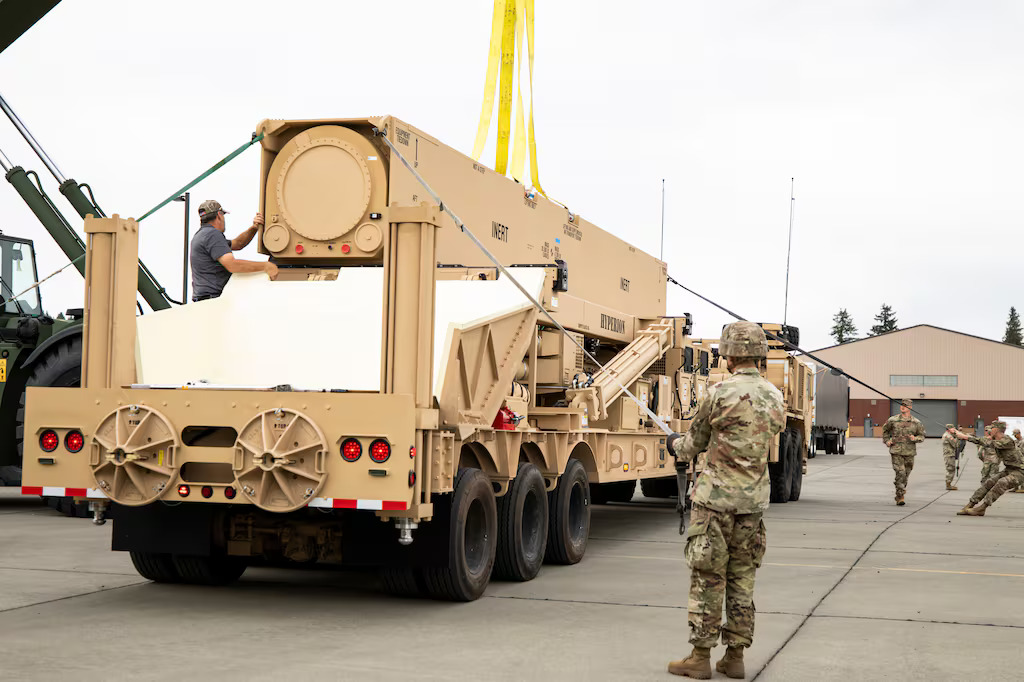
Following a lengthy delay as the U.S. Army and Navy struggled to test the round, the Army will field its long-range hypersonic weapon to the first unit by the end of fiscal 2025, a defense official confirmed Wednesday in a statement to Defense News.

The Army had planned to field the live, ground-launched hypersonic rounds to the 1st Multi-Domain Task Force, 5th Battalion, 3rd Field Artillery Regiment, 17th Field Artillery Brigade unit at Joint Base Lewis-McChord in Washington state by the fall of 2023. But the milestone continued to be pushed back after several aborted tests in 2023 due to challenges at the range, related not to the round, but the process of firing up the missile for launch.


SECNAV nominee says he’ll bring ‘urgency’ to Navy’s shipbuilding

WASHINGTON — The nominee for Navy secretary pledged to lawmakers he’d be focused on correcting the course of problematic shipbuilding programs as well as replenishing dwindling munitions stockpiles, while largely avoiding any significant controversy.

John Phelan, a prominent financier and GOP campaign donor who was tapped to become Navy secretary a few weeks after President Donald Trump won the election, testified today before the Senate Armed Services Committee and appeared poised for an easy confirmation.

“I think what is missing from what I can see is a sense of urgency,” Phelan said of the Navy’s shipbuilding record. “We’re just going along and everybody — it’s Kumbaya. It’s almost as if you’re waiting for a crisis to happen to ignite things. And I think in the business of warfare, that’s a dangerous place to be. So I think why the president selected me is I will bring a sense of urgency to this. I will bring a sense of accountability to this.”

Companies are coming to Texas to develop a new generation of nuclear reactors

The West Texas city of Abilene is better known for country music and rodeos than advanced nuclear physics. But that’s where scientists are entering the final stretch of a race to boot up the next generation of American atomic energy.

Amid a flurry of nuclear startups around the country, Abilene-based Natura Resources is one of just two companies with permits from the U.S. Nuclear Regulatory Commission to construct a so-called “advanced” reactor. It will build its small, one megawatt molten salt reactor beneath a newly-completed laboratory at Abilene Christian University, in an underground trench 25 feet deep and 80 feet long, covered by a concrete lid and serviced by a 40-ton construction crane.

DOD wants to cut red tape on foreign arms deals, Hegseth says

The Defense Department wants to reform how it sells weapons to foreign countries, Defense Secretary Pete Hegseth said Thursday.

The U.S. foreign military sales, or FMS, process involves years of back-and-forth between the U.S. and countries interested in buying American-made weapons before anything ends up on foreign soil. The process, which has been criticized for its slow pace, has been the focus of reform efforts prompted by the war in Ukraine.

Navy League urges rapid expansion of battle fleet for future wars

U.S. leaders should invest at least $40 billion every year to grow and maintain the country’s fleet of battle force ships in preparation for long-term and large-scale wars, the nonprofit Navy League urged in a policy statement unveiled in early February.

The statement also called on Congress to increase funding for a Navy plan to revitalize public shipyards, add to the Coast Guard’s fleet of polar icebreakers and spend more on producing munitions to prepare for a “possible great power conflict.”

Trump’s missile shield marks shift in homeland defense strategy

President Donald Trump’s executive order to develop a next-generation homeland missile defense shield marks a shift in the United States’ long-standing homeland missile defense strategy, which has focused on threats from rogue nations like North Korea and Iran rather than from peer adversaries like China or Russia.

The order — titled “The Iron Dome For America” in a nod to the successful, lowest tier of Israel’s multilayered air defense system of the same name — also addresses a broader array of complex threats from hypersonic weapons to cruise missiles.

Pentagon Prepares to Deploy Thousands of Troops From Combat Units to Southwest Border

WASHINGTON—The Pentagon on Friday readied more than 5,000 troops from high-profile warfighting units to deploy to the southwestern U.S., moving to fulfill President Trump’s order to escalate the military role along the border.

Armed infantry and support troops from the 82nd Airborne Division and the 10th Mountain Division—two of the Army’s most experienced combat formations—could be at the border within days, one defense official said, following Trump’s Jan. 20 declaration that what he called an “invasion” of migrants, drug cartels and smugglers would be met with a military response.

Navy shipbuilding plan would cost $1 trillion over the next 30 years

For the U.S. Navy to achieve a proposed plan to expand its fleet of battle force ships, the service would need to spend $40.1 billion on shipbuilding every year through 2054, for a total of more than $1 trillion, according to new analysis from the Congressional Budget Office.

Over the next 30 years, the Navy wants to grow its fleet of battle force ships to 381 to face swelling global threats, according to the service’s most recent proposal. There are currently 295 in the fleet, and that number is expected to drop to 283 ships in 2027, when the Navy is planning to retire 13 more ships than it will commission.

Space Development Agency validates high-speed satellite comm links

York Space Systems and SpaceX, two companies building satellites for the Space Development Agency’s megaconstellation, recently demonstrated the ability to connect two of their on-orbit spacecraft through a laser link.

During the demonstration, York linked one of the communication satellites it built for the first iteration of SDA’s constellation with a SpaceX missile tracking satellite. The laser communication links the companies used allow the satellites to transmit information quickly and securely.

Pentagon’s 2025 industry investments target space, biochem and more

The Pentagon’s strategic capital office will focus its 2025 investments on 15 industry segments it thinks could most support U.S. national security needs, including spacecraft, microelectronics materials and manufacturing and biochemicals.

The office released its fiscal 2025 investment strategy Thursday, offering a snapshot of its priorities for the coming year.

“Investments will be prioritized based on their national security impacts, defined as those that provide the United States and/or its allies and partners with robust competitive advantage relative to strategic competitors,” the document states.

Defense Secretary Lloyd Austin established the Office of Strategic Capital in 2022 to help direct private sector capital to defense technologies. The following year, Congress gave the organization authority to offer loans and loan guarantees to companies.